TITLE: Erosion
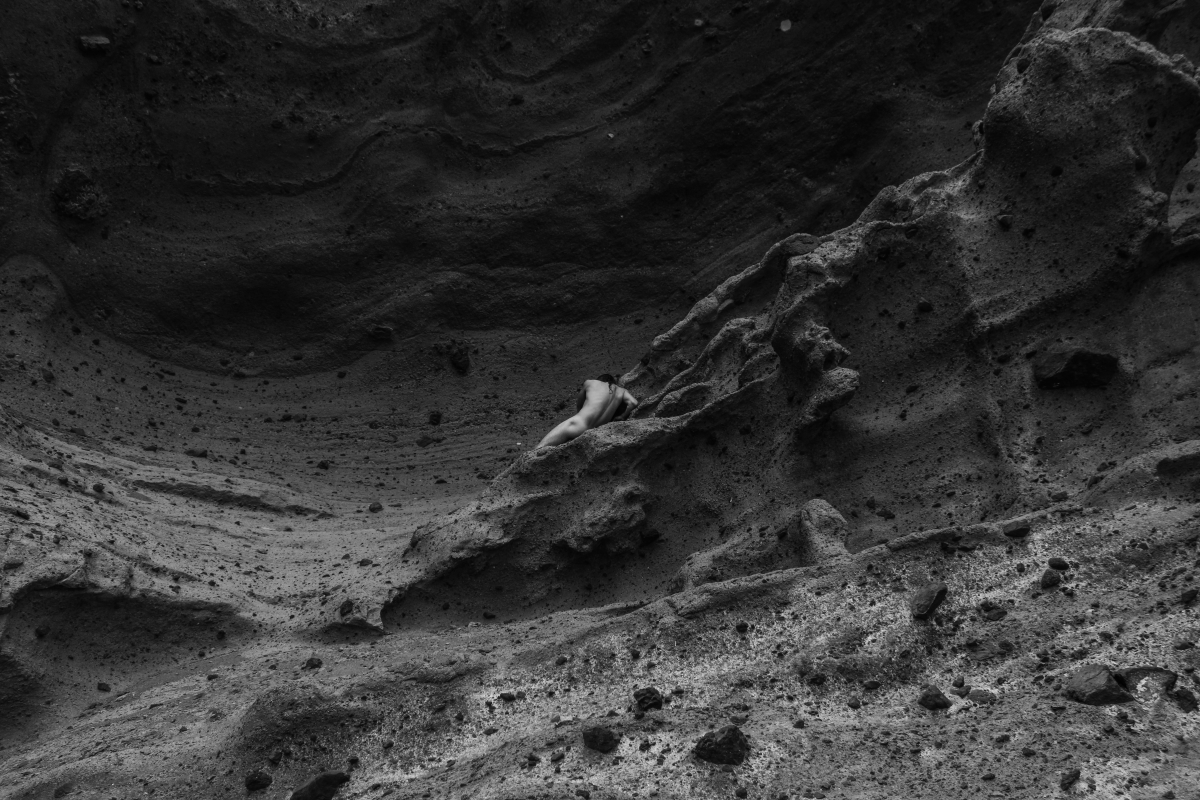
Erosion explores the passage of time and the silent trace it leaves on matter and on the body. Rather than understanding erosion as a violent process, this image approaches it from a subtle perspective, as a slow transformation that occurs almost unnoticed, yet alters everything.
With this work, I wanted to reflect the grandeur of nature in contrast to the human being, a human who, in many ways, has forgotten it. The image proposes an encounter between the two, a union in which body and stone merge to form a single entity. The human figure appears reduced, integrated into the natural matter, becoming difficult to distinguish from the surface that surrounds it.
The photograph focuses on texture and form, inviting the viewer to pause and observe details that often go unnoticed. The use of monochrome removes distractions and directs attention to the dialogue between light and shadow, between fragility and resistance. What seems solid begins to reveal vulnerability, while what appears fragile gains presence.
Erosion functions here as a metaphor for the passage of time, a time that today often generates fear or rejection. However, in this image, time does not act as a threat, but as an element that transforms and beautifies. Erosion does not erase; it reveals. It does not destroy; it gives form and meaning.
The approach to this photograph was intuitive. Rather than imposing a predefined idea, I was interested in observing, framing, and allowing the image to be constructed through light and attention to detail. Photographing thus became a way of understanding the relationship between human beings and nature, and of accepting the passage of time as an essential part of that union.
AUTHOR: Magali Lacoste Bregaña (Spain)
I am a photographer in the process of discovering the language of images. Although I have always been drawn to photography, it was not until recently that I had direct contact with it. I study Restoration and Conservation of Cultural Heritage in Tenerife, and it was through a photography course that I began to understand how a camera works and how to capture the world as I perceive it. Learning about light, composition, and the mechanics of photography felt almost magical, and it opened a door to a new way of seeing.
In my first photographic project, I created a series of images that felt entirely my own. This experience confirmed that photography was something I wanted to explore more deeply. I am still learning, but I am fascinated by the process of translating what I see and feel into a visual language that can connect with others. Each photograph is an opportunity to reflect on the passage of time, memory, and the relationship between humanity and nature.
My work often explores the interaction between humans and the natural world, seeking to find moments where they merge, coexist, or contrast. I am drawn to texture, light, and subtle forms of transformation that reveal beauty in imperfection and change. In my series Erosion, for example, I wanted to show the grandeur of nature alongside the human presence, a presence that is often small, fragile, yet inseparable from the environment. This approach allows me to explore themes of time, resilience, and the quiet poetry found in everyday existence.
I approach photography intuitively, observing, framing, and letting the image emerge rather than forcing it. I am fascinated by the small variations that light, angle, and perspective can make in the perception of an image. Photography for me is not only a way of capturing reality but also a tool for understanding and connecting with it on a deeper level.
Through my work, I hope to invite viewers to pause, reflect, and feel a sense of connection with the world around them. I am motivated by curiosity, emotion, and a desire to explore this visual language more fully, to continue learning, and to share the intimate stories that photography allows me to tell.
SHARE
Support this photographer - share this work on Facebook.