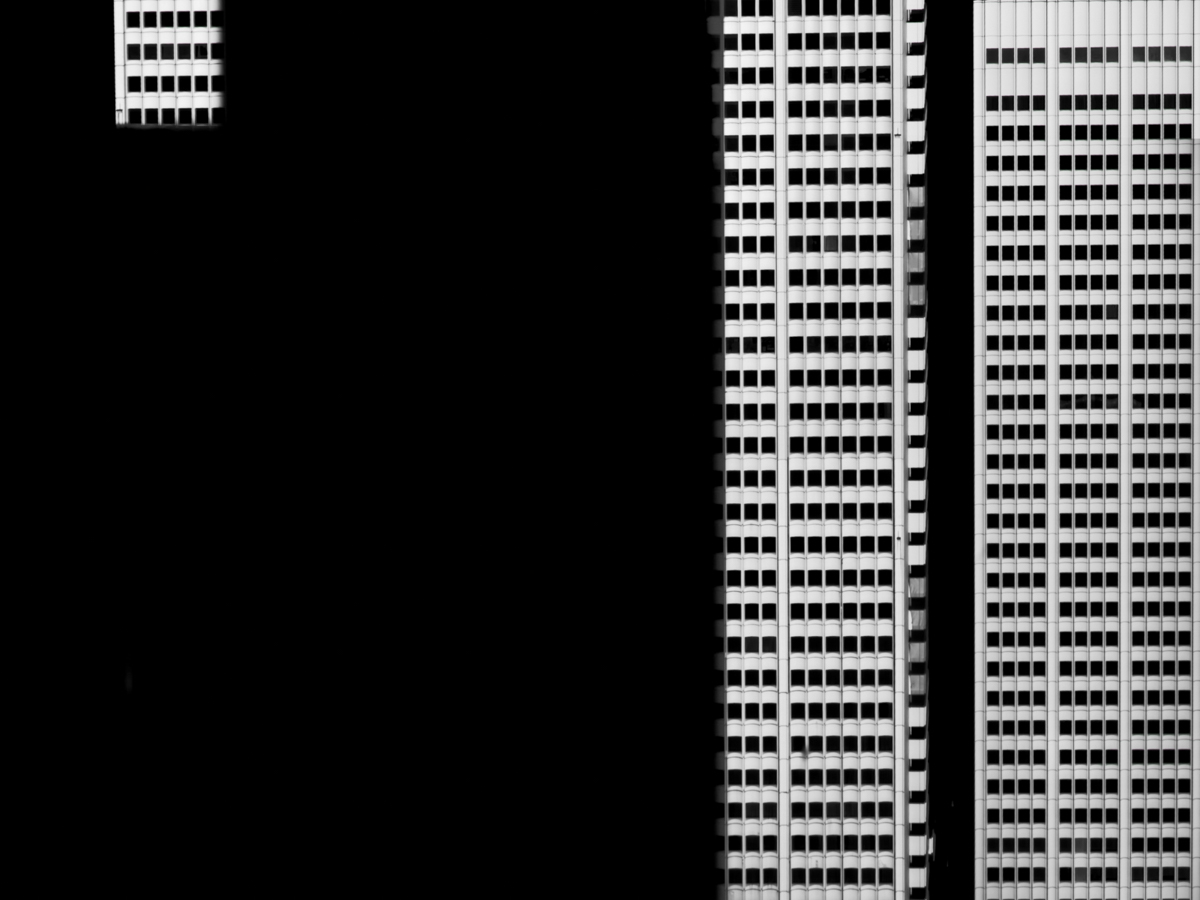
TITLE: Shaded City
Two fragments of city block, separated by a void of absolute black, fill the frame from edge to edge with no sky, no ground and no concession to context or location. The buildings are unidentifiable — stripped of address, function and civic identity — reduced to their essential geometry: a relentless grid of windows and structural mullions that repeats until the eye loses count. The small isolated fragment in the upper left, adrift in the darkness, prevents the image from becoming mere pattern and introduces a quiet tension — something separated, something peripheral, something that didn't quite make it into the light. Shot in monochrome to push the contrast between the luminous white façades and the consuming black void to its maximum, this is less a photograph of buildings than a meditation on the nature of urban mass — the city as an arrangement of surfaces that admit or deny light on their own terms, indifferent to the people inside them.
AUTHOR: Cliff Spooner (United Kingdom)
Cliff's photography defies easy categorisation, which is precisely the point. A geologist by training, he reads landscapes the way most people read faces — for what lies beneath the surface, for the tension between structure and erosion, for the story that only deep time tells. That habit of looking has shaped everything he shoots.
His competitive record spans wildlife, landscape, abstract, street, and digital art across PAGB, FIAP, PSA, and RPS frameworks, with distinctions including ARPS. He's as comfortable stalking critically endangered spoon-billed sandpipers on the mudflats of Thailand's Gulf Coast as he is constructing a composed studio nude or building a displacement-processed architectural abstract in post. The common thread isn't genre — it's an obsession with formal rigour and the point at which a photograph stops being a record and starts being something else entirely.
The art nude series submitted here grew from that same instinct. Light as geology — raking, revealing, unforgiving. The body treated not as subject but as terrain: ridgelines, shadow valleys, the slow arc of a form emerging from darkness. Black-and-white was never in question. Colour would have been a distraction from the thing itself.
Away from the camera, Cliff sails — which teaches you, among other things, that conditions are rarely what you planned for and that the interesting picture usually happens when you've just put the camera away. He also performs in amateur stage productions, which turns out to be surprisingly useful training for directing a subject: knowing when to give instruction, when to stay quiet, and when the moment you wanted has already passed.
The sea, the stage, the studio, the shoreline. Different disciplines with the same underlying question — what does it take to hold someone's attention, and for how long?
SHARE
Support this photographer - share this work on Facebook.