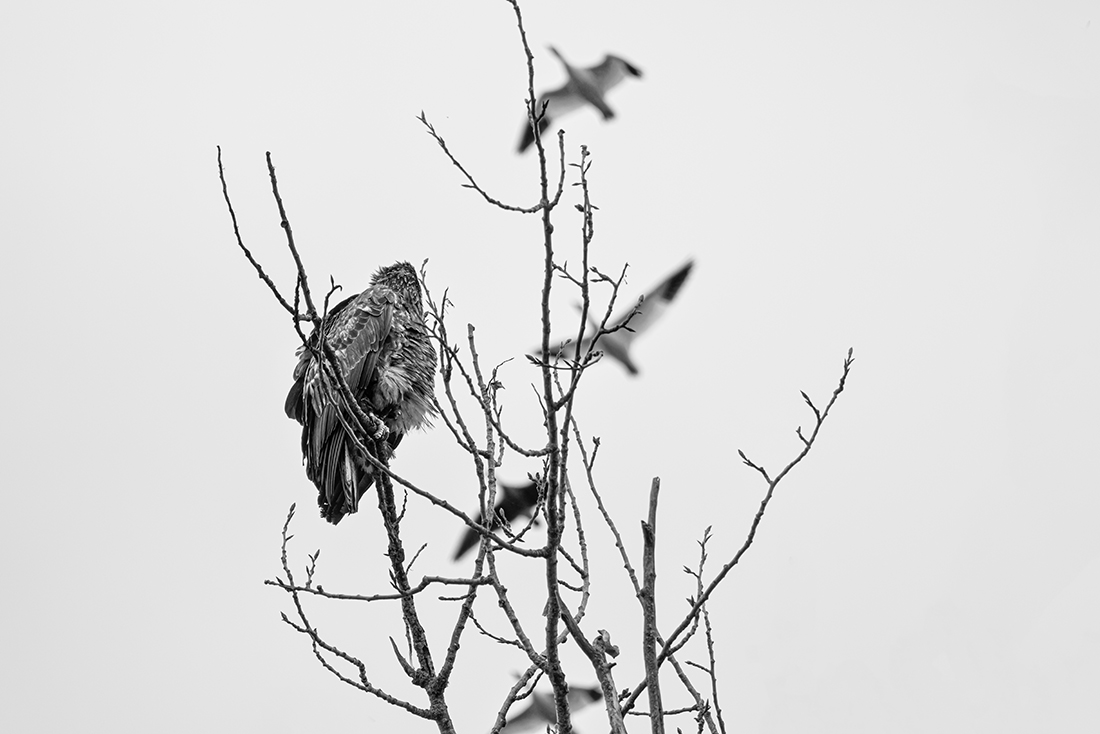
TITLE: Cloudy Day on a Wetland
This series of images were shot in a temperate wetland over the course of 3 days. This wetlands, in Oregon, is a dedicated wildlife refuge and sustains several species of migratory and local waterfowl along with their raptor predators.
Species of waterfowl include Sandhill Cranes and Snow and Canada Geese, and Tundra and Trumpet Swans. Other common waterfowl include various species of ducks. Though less common, the ecosystem also sustained Great Blue Herons and Great Egrets. Species of raptors include Northern Harriers, Goshawks, Red-Tailed Hawks, Ospreys, and Bald Eagles.
In this series of photographs, I aim to capture close portraits of these species and their behaviors with minimal distraction from their environment. In particular, I hope to display the structural beauty of these species.
This series of photographs captures the following:
1) Juvenile Bald Eagle looking up at a common prey, Snow and Canada Geese, with one talon firmly grasping the branch
2) Northern Goshawk displaying its spread-wings and, while drying off, accentuating the branches of the tree
3) Northern Harrier peering through a leafless forest, illuminated by the glaze of a setting sun
4) Red-Tailed Hawk disembarks to begin another fly-by scan of the wetlands
5) Juvenile Bald Eagle soaring overhead, scanning for prey
6) Pair of Tundra Swans with outstretched translucent wings, regrouping with their bank
7) Triad of Sandhill Cranes, gliding over the wetlands, peering towards their grounded sedge
8) Mixed swarm of Snow and Canada Geese, taking off from the wetlands in unison
Note to reviewer:
The submitted images have suffered a major loss in quality due to the upload requirement of 1100px on longest side. Details needed to convey the intention of image are not visible (eg. the eye of harrier in #3). Please reach out for the originals for proper appraisal.
AUTHOR: Anerudh Kannan (United States)
As a Photographer Scientist - turned - Computer manufacturing Engineer, I have had intimate experience using photons and optics to interrogate and manipulate natural and synthetic environments. As a youth, I would spend countless hours on the decks or bridge wings of cargo vessels waiting for the perfect moment to photograph ocean wildlife. I then pursued natural sciences in diverse fields, employing optical technologies to interrogate physical and biophysical systems. Later, I worked as a software engineer developing image segmentation algorithms to assist the manufacturing of a couple dozen-atoms-wide semiconductor transistors, that power virtually all modern electronics.
I continue my passion for nature, primarily via photography, and have interest in using my talent in conservation and educational efforts.
SHARE
Support this photographer - share this work on Facebook.